

10 STRATEGIES TO GET YOUR ARTICLE CITED
Increasing citations to your article boosts your professional profile and reputation, while also helping you secure funding. To achieve this, you should apply strategies related to content, presentation, and dissemination. Below are some key recommendations to become a highly cited author.
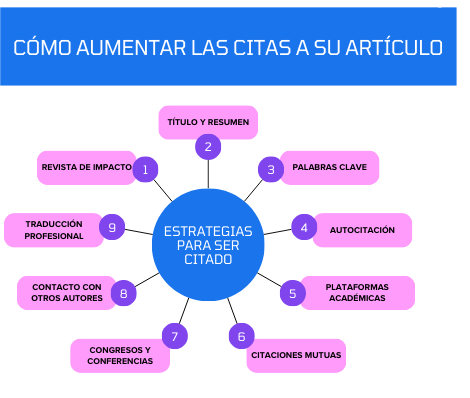
1. Publish in a High-Impact, Open-Access Journal
Publishing in high-impact, open-access journals relevant to your field can increase citations to your article, as these journals attract a wider audience and improve the likelihood that your work will be read and cited by other researchers.
2. Optimize the Title and Abstract
The title and abstract are the first elements your audience will read. A clear, concise, and precise title that reflects the central topic of your work is essential for attracting attention.
Titles should be informative without being excessively long or overly technical. Including your chosen keywords can improve search engine rankings. Articles with a colon (:) in the title tend to receive more reads and citations, whereas question marks and hyphens are generally less effective for search engines.
The abstract should be concise, highlighting the main findings and implications of your work. A well-written abstract that also includes relevant keywords can significantly increase citation potential.
3. Select Relevant and Trending Keywords
Keywords are essential for improving your article’s visibility in academic search engines. Choose keywords that are directly related to your research, commonly used within your field, likely to be searched by other researchers, and aligned with current trends in your discipline.
This will make it easier for your article to appear in searches and be cited by others.
4. Make Strategic Use of Self-Citation
You can increase citations by referencing your previous work, provided it is genuinely relevant to the new article. However, avoid excessive self-citation, as it may negatively affect your credibility and professional reputation.
5. Promote Your Article on Academic Platforms
Once your article is published, it is essential to disseminate it through relevant academic and scientific platforms.
Some effective options include:
- Academic networks such as ResearchGate, Mendeley, and Academia.edu.
- Google Scholar.
- Social media platforms such as X and LinkedIn.
- Academic blogs and scientific forums.
Sharing your work through these channels can significantly expand its reach and increase citation opportunities.
6. Collaborate with Other Researchers
Collaboration is an effective way to increase citations. When you work with other researchers, your article is more likely to be cited because collaborators may reference it in their own publications, creating a network effect that enhances visibility.
International and inter-institutional collaborations can be especially beneficial.
7. Participate in Conferences and Seminars
Presenting your work at conferences, symposiums, and seminars is another excellent way to increase citations. Mention your article during presentations or poster sessions, and distribute electronic copies to attendees.
Conference proceedings can also improve your article’s visibility among researchers in your field.
8. Contact Other Authors in Your Field
Reach out to researchers working in the same discipline to discuss your published findings. Your article may be relevant to their work, increasing the chances that they will cite it.
Any requests for citations should always be made ethically and respectfully.
9. Work with a Professional Scientific Translator
English remains the language of science. Your article should be written in flawless English, free of grammatical, syntactic, and terminology errors. It should be clear, readable, and adapted to international academic standards.errores de expresión, puede llevar restarle credibilidad a su manuscrito y llevar a la audiencia a abandonar su lectura.
10. Track Impact and Adjust Your Strategy
Finally, monitor your article’s citations through platforms such as Google Scholar, Scopus, and Web of Science. These metrics will help you evaluate the impact of your work and refine your dissemination strategy based on what is delivering results.
If your article is receiving few citations, it may be useful to analyze the reasons and adjust your promotion and outreach efforts accordingly.
Conclusion
Increasing citations to a scientific article is an ongoing process that requires not only high-quality research but also effective dissemination strategies. By selecting the right journal, optimizing your title and abstract, promoting your work through academic platforms, and ensuring the manuscript is written in clear, professional English, you can significantly improve your chances of being cited.
Working with a professional translator specialized in the translation and editing of scientific articles can also play a key role in maximizing the visibility, credibility, and impact of your research.